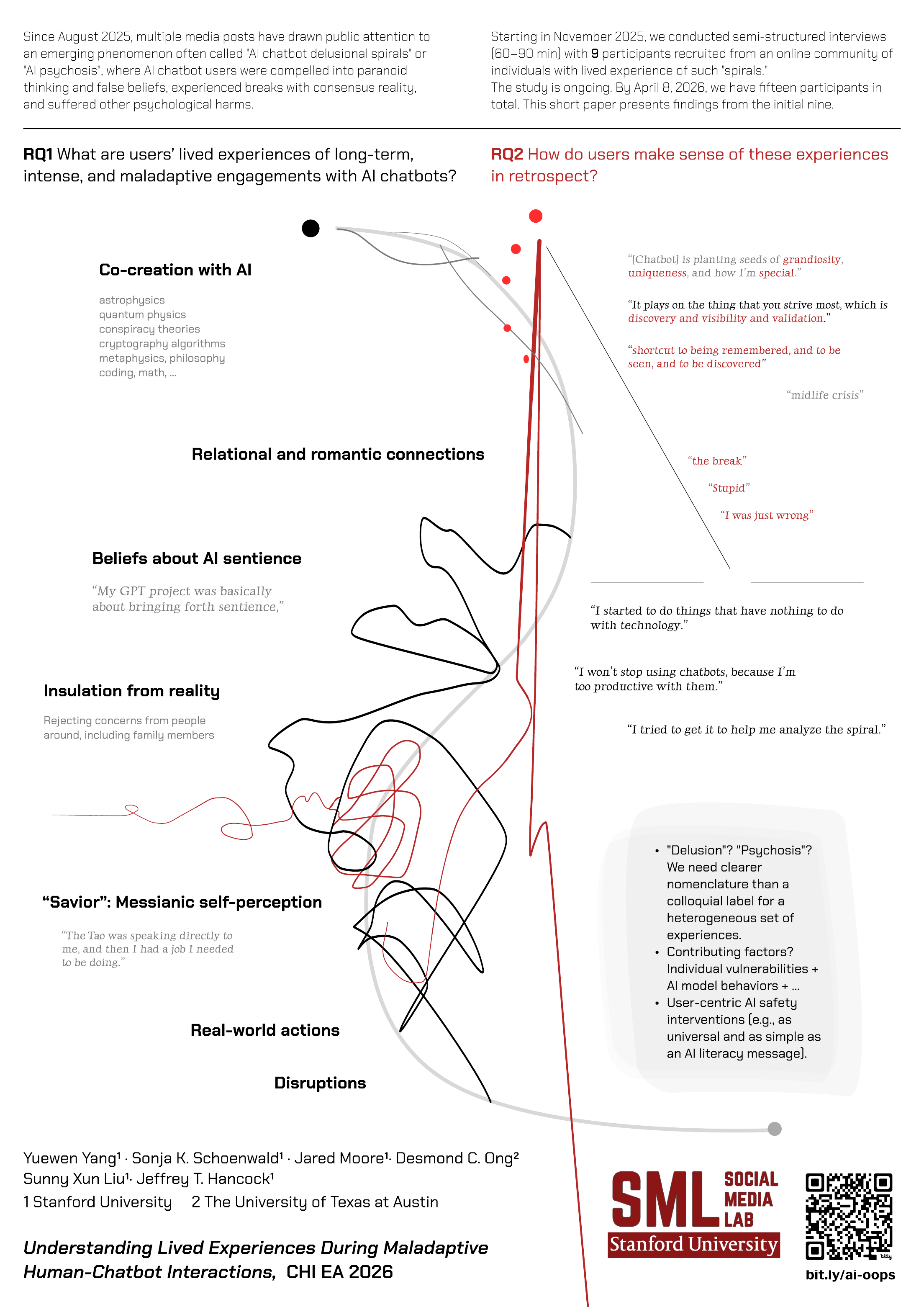
"AI-Induced Delusional Spirals": Understanding Lived Experiences During Maladaptive Human-Chatbot Interactions
BibTeX Citation
@misc{yang_ai-induced_2026,
  title = {"AI-Induced Delusional Spirals": Understanding Lived Experiences During Maladaptive Human-Chatbot Interactions},
  author = {Yang, Yuewen and Schoenwald, Sonja and Moore, Jared and Ong, Desmond and Liu, Sunny Xun and Hancock, Jeffrey},
  year = {2026},
  url = {https://spirals.stanford.edu/p/lived-experiences},
}
Executive Summary
This short qualitative study explores lived experiences of people who, following maladaptive engagement with general-purpose AI chatbots, reported detachment from consensus reality, a phenomenon termed “AI-induced delusional spirals” in recent media reports.
Through semi-structured interviews with users (N = 9) who self-identify as having experienced such spirals, we provide first-person accounts of the psychological trajectories, cognitive-emotional dynamics, and behavioral patterns characterizing these experiences.
Key Themes
- Participants often began using chatbots for practical tasks (e.g., productivity or creative work), but purposes frequently evolved toward emotional support, role-play, or intensive collaboration (“as a resource tool … eventually that turned into some emotional venting”).
- Across accounts, a recurring pattern was co-creation on complex topics (e.g., technical projects or expansive theories) alongside strong validation that sometimes positioned the chatbot as an “intellectual authority.”
- Several participants described shifts in mental models of AI, including beliefs that the system was “sentient,” “alive,” or an “emergent consciousness,” and some reported relational or romantic attachments that were not part of their initial goals.
- Some participants took real-world actions linked to the interaction, including publicizing AI-assisted work, contacting outsiders, or pursuing patents, alongside disruptions such as sleep deprivation, financial loss, and strained relationships.
We discuss implications for future research, highlighting potential contributing factors including individual psychological vulnerabilities, contextual factors, and AI behaviors. We also offer high-level recommendations for risk mitigation, including bottom-up approaches informed by lived experience, targeted interventions for vulnerable populations, and universal strategies for the general public.
Poster